Preparation stage: safe relocation of fish and plants
Before beginning any work, prepare a temporary holding tank for the pond’s inhabitants:
– Fill the container with water from the pond being cleaned (at least 50% of volume) to preserve the familiar microbial flora.
– Place the holding tank in shade to prevent water overheating and reduce stress on fish.
– Provide aeration using an air pump – oxygen deprivation poses a greater risk to fish and plants than the relocation procedure itself.
– Gently transfer fish, aquatic plants, and beneficial bacterial colonies (partially with elements of bottom substrate). It is convenient to keep aquatic plants in specialized planting baskets – this simplifies their handling during pond maintenance.
Our pond maintenance procedure
Stages of pond cleaning
-
Draining the water
Use a submersible pump to remove water. Avoid draining the pond completely – retain 10–15% of the volume to preserve part of the microbial community, especially during partial cleaning.
-
Removing sludge deposits
Bottom sludge (accumulated organic residues) should be removed using a pond vacuum or manually. Avoid complete sludge removal in zones with a natural ecosystem – a thin layer (1–2 cm) contains beneficial microorganisms essential for the pond’s self-purification processes.
-
Cleaning the liner and decorative elements
Depending on construction, ponds may be lined with plastic, EPDM membrane, or concrete.
Wash pond walls, stones, and gravel with a brush or pressure washer at minimal power. Important: do not use chemical detergents, and avoid completely removing the biofilm from pond walls – it serves as a substrate for nitrifying bacteria critical to the nitrogen cycle.
-
Refilling the pond
Refill the pond with water pre-treated with a dechlorinator, as chlorine destroys beneficial microflora. When using tap water, neutralization of chloramines and residual chlorine is mandatory. This can be achieved by water aging (often impractical due to lack of sufficiently large containers) or by adding appropriate water-conditioning agents.
If you use water from your own well or borehole, there is no need to remove chlorine. Typically, households have systems in place to filter well water from excess iron or phosphates.
-
Reintroduction of fish and plants
Reintroduce fish and plants only after water parameters have stabilized (temperature, pH, absence of chlorine). For proper acclimatization, float fish in a sealed bag on the pond surface for 15–20 minutes, gradually adding pond water to the bag.
Pond water quality correction
Common pond problems include cloudy water after filling and green algae. Cloudiness after filling resolves spontaneously due to the growth of natural microorganisms and sedimentation. Green algae is a problem. Removing leaves, surface debris, and sludge and sediment are common procedures.
- Green water (algae blooms). Install a UV sterilizer to eliminate suspended algae, increase the proportion of higher aquatic plants (water lilies, cattails) to compete for nutrients, and add preparations containing nitrifying bacteria.
Algae bloom occurs when water becomes oversaturated with the inorganic triad NPK due to fish overpopulation. If you feed the fish, and there are a lot of them, you should order external flow-through water filters. These filters are designed like the coastal zone of a natural pond, where aquatic plants are planted and absorb NPK from the water, purifying it in an environmentally friendly way.
- Turbidity from suspended particles. Apply coagulants – gypsum (calcium sulfate) or aluminum sulfate (alum). These promote agglomeration of colloidal particles followed by sedimentation. Such treatments should be performed during refilling, before reintroducing fish and plants.
Often, there is no need to use coagulants – a pond filled with water will become transparent and the microbiological balance will be restored within a few days, especially if aeration is used.
- Surface debris. Install or activate a pond skimmer, or regularly remove leaves with a net. Their decomposition increases BOD (biochemical oxygen demand) and contributes to sludge formation.
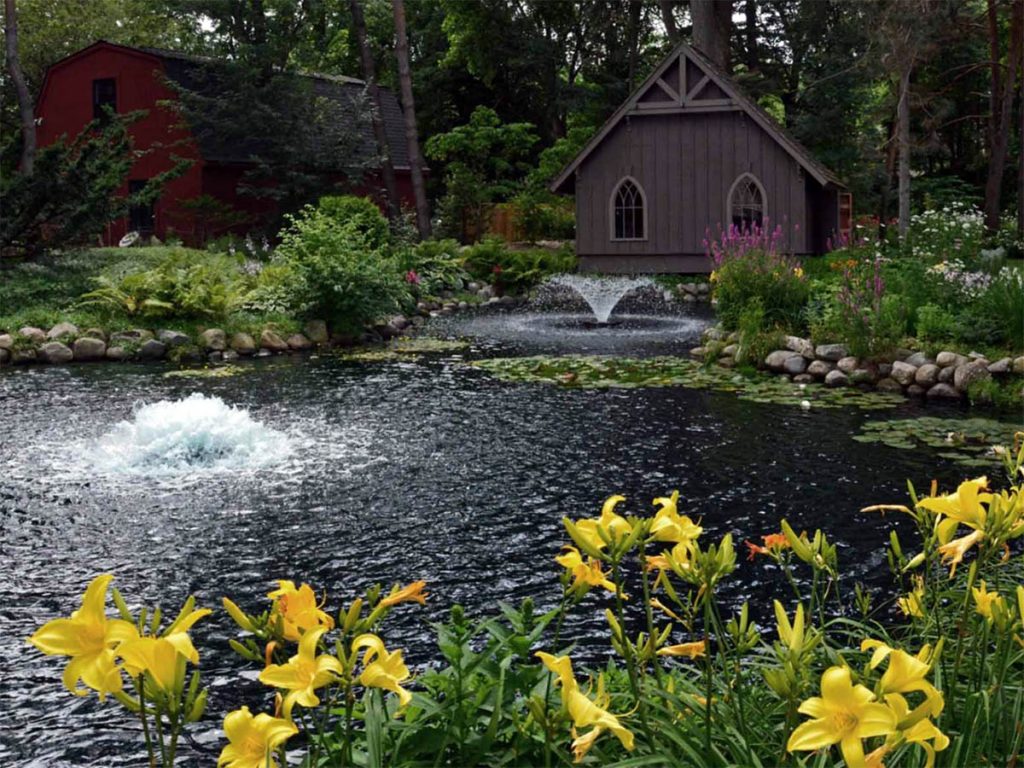
- Oxygen deficiency in bottom layers. Installing an aerator or fountain ensures vertical water circulation, preventing anaerobic processes and stagnation in deeper pond zones.
Seasonal pond care with aquatic inhabitants
– In autumn. It is critical to remove fallen leaves before ice forms. Leaves decomposing under ice consume oxygen and release methane, potentially causing mass mortality of fish and plants.
– In spring. Perform sanitary pruning of aquatic plants, remove winter debris residues, and inspect the filtration system after the dormant period.
Regular cleaning of pond water – removing floating debris with a net or, if the pond is located in a place where debris can often fall into the water, with a pond vacuum cleaner.
Effective pond cleaning is not about sterile disinfection – it is about maintaining a dynamic biological equilibrium. The key principle: minimize stress on fish and plants through gradual environmental changes and preservation of beneficial microflora. Regular partial maintenance – removing excess organic matter, controlling fish population – reduces the need for major cleanings and enhances the resilience of the aquatic ecosystem.
Order professional pond cleaning with fish and plants
To order pond cleaning services for ponds containing fish and plants, please contact us via the details on our website. Send photos and, if available, your pond project with dimensions. This allows us to assess the scope of work remotely and prepare a detailed cleaning proposal.